Outreaching Activities from the
COOPER LAB
at the University of Kentucky


2018- Working with teachers- "Turning STEM Majors Into STEM Educators" -http://uknow.uky.edu/research/turning-stem-majors-stem-educators?j=52037&sfmc_sub=122681923&l=16891_HTML&u=1182277&mid=10966798&jb=0 https://bio.as.uky.edu/turning-stem-majors-stem-educators
My views on Unversity faculty working with teachers in K-12 and teacher workshops.... PDF or MS word
Read all about UK's commitment to Outreaching for KY Young Researchers--- Click here--
Outreach activities from the Cooper lab for 2015 Fall - 2016 Spring (here PDF)
Class participantion for UK's Bio 446/650 with Ms. Shannon Conlin, a marine biologist, (Swansea University, United Kingdom) See movie clip http://web.as.uky.edu/Biology/faculty/cooper/Bio450-AS300/Intro%20Video%20ShannonC.mov
Science outreach international: The 2017 Belize (Central America) Adventure (Download PDF)
BioBonanza day 2016 for the Biology Department https://bio.as.uky.edu/galleries/biobonanza
KBRIN INBRE Summer Undergraduate Biomedical
Research Program 2014-2016: https://www.youtube.com/watch?v=J6TAwZbCkqc
Clara deCastro hits the NEWS 2015: http://www.kentucky.com/living/family/article44595561.html
deCastro, C., Titlow, J., Majeed, Z.R., and Cooper, R.L. (2014). Examining the usefulness of various salines by physiological assays designed for larval Drosophila melanogaster: heart rate, synaptic transmission at neuromuscular junction and central circuits in the CNS. Journal of Comparative Physiology A 200:83–92, Impact factor 1.856 [PDF]
Healthy Flea Project -- Click here
UK undergrad classes, grad students and faculty blog with middle and high school students about concepts in Health Sciences: http://www.getacclaim.com/blog/biology-stem-and-communication-a-university-of-kentucky-collaboration/
The Healthy Flea Market. Connected Science Learning. National Science Teachers Association (NSTA) On line January 16, 2017. Available at: http://csl.nsta.org/2017/01/the-healthy-flea-market/
(Feb. 17, 2016 see PR in UK NOW on this project: http://uknow.uky.edu/content/community-collaboration-connects-lewis-county-high-schoolers-uk-scientists )
UK College of Nursing home page: http://www.uky.edu/nursing/about-us/news/college-nursing-phd-student-and-alum-engage-kentucky-high-schoolers-collaborative
(see PR in UK NOW on this project: http://uknow.uky.edu/content/uk-project-engages-next-generation-kentuckians-tackle-health-problems )
(see PR within Fayette County Schools http://www.fcps.net/news/features/2014-15/ukmodules )
WORLD WIDE SCIENCE WITHOUT BOARDERS- see https://sites.google.com/site/sciencetalkworldwide/
Health Related Community Service--click here .........FUNDING RELATED TO OUTREACHING --- click here
Click here for content on INTERNATIONAL OUTREACHING
Development of educational resources for middle & high school teachers (Skeletal muscle, Population dynamics, 2D- 3D imaging)
(see PR in UK NOW on this project: http://uknow.uky.edu/content/uk-project-engages-next-generation-kentuckians-tackle-health-problems )
(see PR within Fayette County Schools http://www.fcps.net/news/features/2014-15/ukmodules )
See CV for full listing
Recent activities-
2008-2009 President for the Kentucky Academy of Sciences (KAS). Organization of this year's annual meeting at UK Oct 31-Nov. 1st. 600 people attended this meeting. This is a state wide organization to promote science education in the state of KY.
2012-2013 Outreach Coordinator for the Society for Neuroscience-Kentucky chapter.
2012-2013 President
for the Kentucky Chapter for the American Physiological Society. Started
the 501c3.
I started the state wide chapter in the summer of 2012. We had our 1st
state wide meeting. (meeting booklet PDF)
This is a state wide organization to promote science education in the
state of KY. (WEB
SITE)
2012-present. President
of the board for the Kentucky Science & Engineering Fair, (KY-SEF,
INC ( http://www.kysciencefair.eku.edu/
)
This is a state wide organization to promote science education in the
state of KY. (PDF
of Board members)
Activities with KY-SEF: See PR links with Lexmark and KY-SEF
http://innovateky.com/reading-050213/
http://www.kentucky.com/2013/04/27/2617801/lexmark-employees-help-kentucky.html
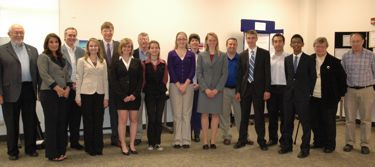
Took our State
fair winners with TEAM KY to the INTERNATIONAL INTEL 2013
Science & Engineering Fair in Phoenix, AZ. Winners
listed here (PDF)
................................................................................................................................................................................................................................................................
My lab members and I are strongly dedicated to outreaching efforts in K-12 schools which involves students and teachers. The efforts were awarded in receiving the KAS (Kentucky Academy of Science) Outstanding College/University Teacher award of 2012-2013. The qualifications: The recipient shall have made significant contribution primarily to science teaching but also to research at the college/university level in Kentucky.
Listing for 2012 related K-12 outreaching activities (click here)
Participate in the Korean-American society to promote research collaborations (click here)
Personally and my lab (Graduate and Undergraduate students) have several initiatives that are on going.
Highlights of such activities are as follows:
1. Involvement in local elementary, middle and high school science fairs and science fun days.
Glendover elementary and Morton middle schools have been a focus for the last several years and we are hoping to spread the efforts to a wider range of schools. I, several graduate and undergraduate students in Biology run the Science fun day and organize the poster judging for some 200+ projects.
As
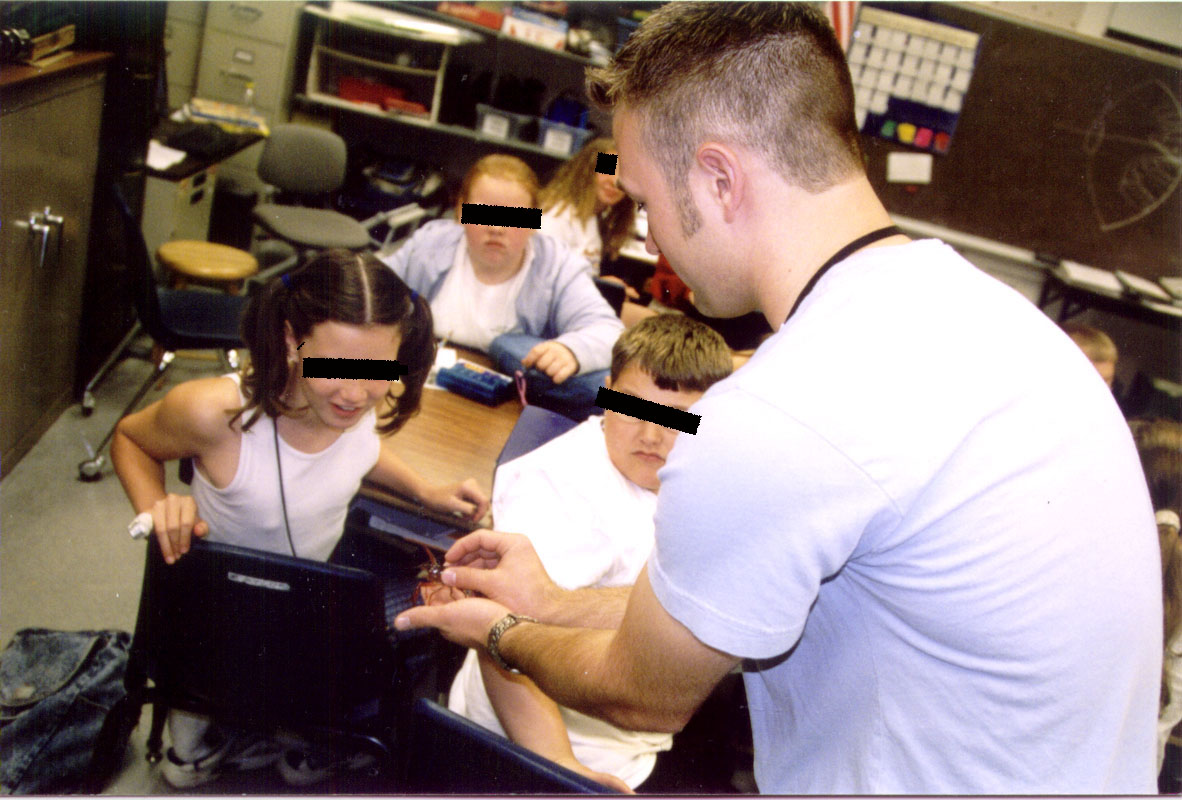
an Biology undergraduate Justin Blackburn (who worked in my research team for
1 year) helped to develop Science Day at Berea Community School. He held hands
on workshops for the students in middle-elementary school.
 ...
... 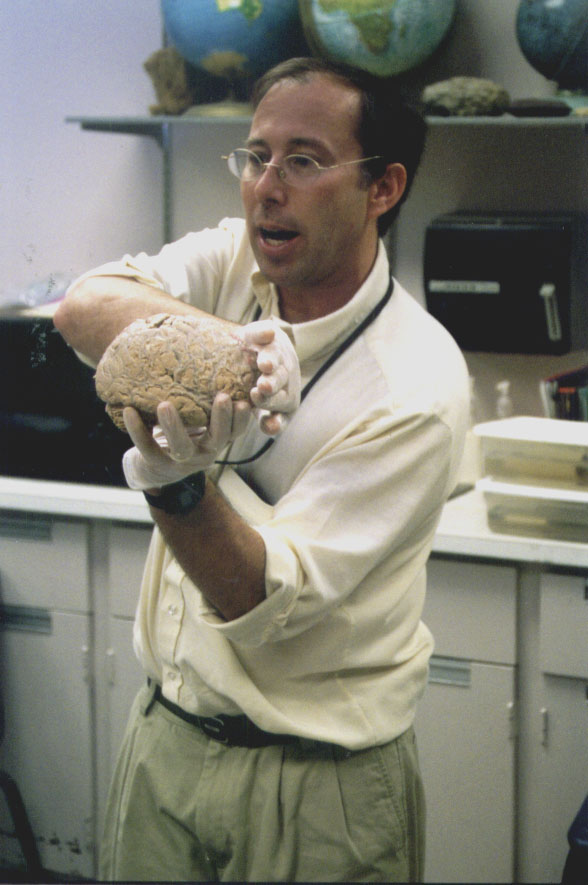 (Cooper)
(JUSTIN Above)
Justin
Blackburn liked this so much that he applied with the help Dr. Robin Cooper (Biology)
for funds from the National Science foundation to learn more of what it takes
to be a science teacher at a High School.
With the $5,000 NSF-REU award Mr.
Justin L. Blackburn provided assistance in a biology classroom at Berea Community
High School (BCHS) for the year of 2005. The NSF-REU
is a special award for Research Experience
for Undergraduates. In this case he used the award
for an experience for learning how to teach science.
Various local, state, national and international activities with service/outreach are listed in Cooper's Resume: (PDF)
2. Not only are we dedicated to helping students but also science teachers.
Teacher Workshops:
One initiative is to work with the Fayette County Public schools and Biology faculty to conduct workshops in the summer for teachers and to continue with teachers education throughout the year.
* Teacher workshops 2013-2014. Kentucky Department of Education. MUSE - modeling for understanding in science and engineering. Kentucky's Mathematics and Science Partnership (MSP) 2013. Two themes: 1. Global environmental changes induced by man; 2. Health related activities.
Web pages related to topics:
(i) CO2 fun activities for a classroom (click here)
(ii) Global environmantal factors (click here)
*
A
Tiered Mentoring Grant from Kentucky Dept. of Education was awarded to
Mr. David Taylor (Science Coordinator Fayette County Public Schools) to
work with Dr. Robin Cooper (Department of Biology) to mentor middle school
science teachers to learn laboratory and experimental techniques. A hands
on teachers workshop was held this past summer within the Department of
Biology. To learn more about this workshop see: http://web.as.uky.edu/Biology/faculty/cooper/Bio401G/workshopsummer2005.htm
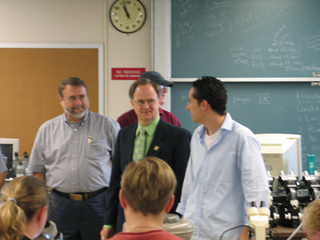 ..................................................................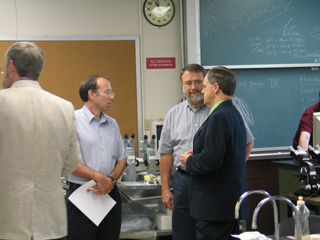
David Taylor, UK President Todd, Nick Badre (Undergraduate
helper in the workshop).
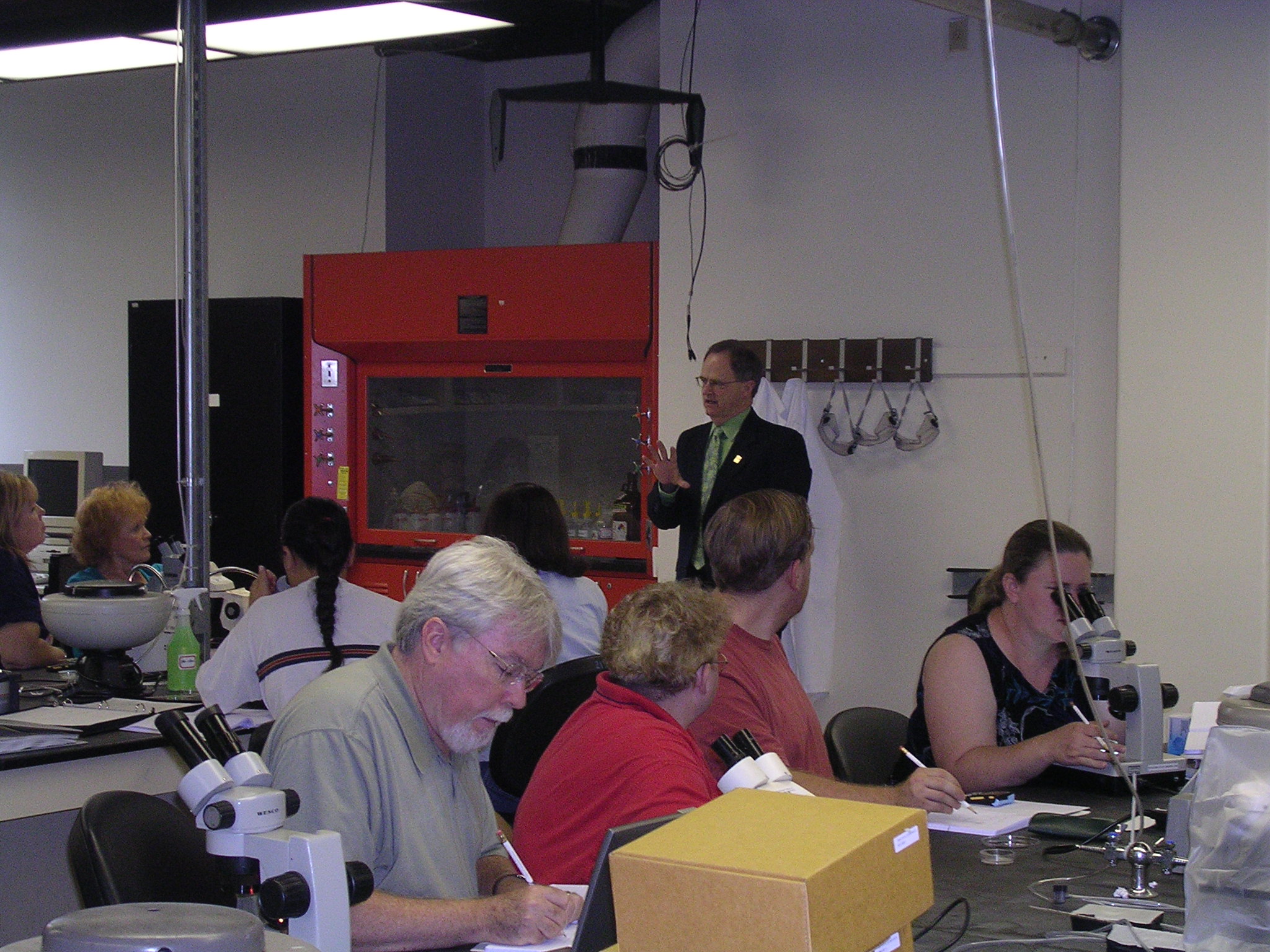
President Todd talking with Middle School Teachers at the workshop relaying the message that UK cares about education at all levels K-12 as well as at the University level.
This KY Department of Education grant also provides the continual contact with The Cooper research team and Middle school teachers throughout the year with FCPS Science Content Academy training.
High School teachers:
I and my lab personal also have a strong commitment with High School teachers as well as High School Students. We have been active at several levels.
This last year
two High school teachers were awarded a NSF-RET
which is a special award for Research
Experience for Teachers
from the National Science Foundation. The grant was a $20,000 supplement
to Dr. Cooper's NSF Research grant. In this case these two teachers were
part of a ongoing NSF funded research project related to understanding
how nerves communicate with muscles. To learn more about the experience
of these two teachers please see: http://web.as.uky.edu/Biology/faculty/cooper/Bio401G/TEACHING
RET PAGE 2005.htm
From this experience one of the high school teachers, Ms. Heidi Anderson from Paul Laurence Dunbar High School wrote a laboratory exercise with Dr. Cooper to use back in her classroom. In addition she submitted this to the National Teachers Association for a competitive award. Ms. Anderson was awarded national recognition for her project. She was awarded Vernier Technology Award which provides a $1,000 for equipment to be used by the school and a free trip to the National Teachers Association meeting as well as a cash prize. She will be honored by the FCPS Board for her accomplishment on February 27, 2006.
Project synopsis is now live on the Vernier web site at http://www.vernier.com/grants/nsta/2006-winners/ (scroll down on page)
 .....
..
.....
..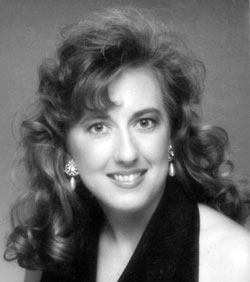 .................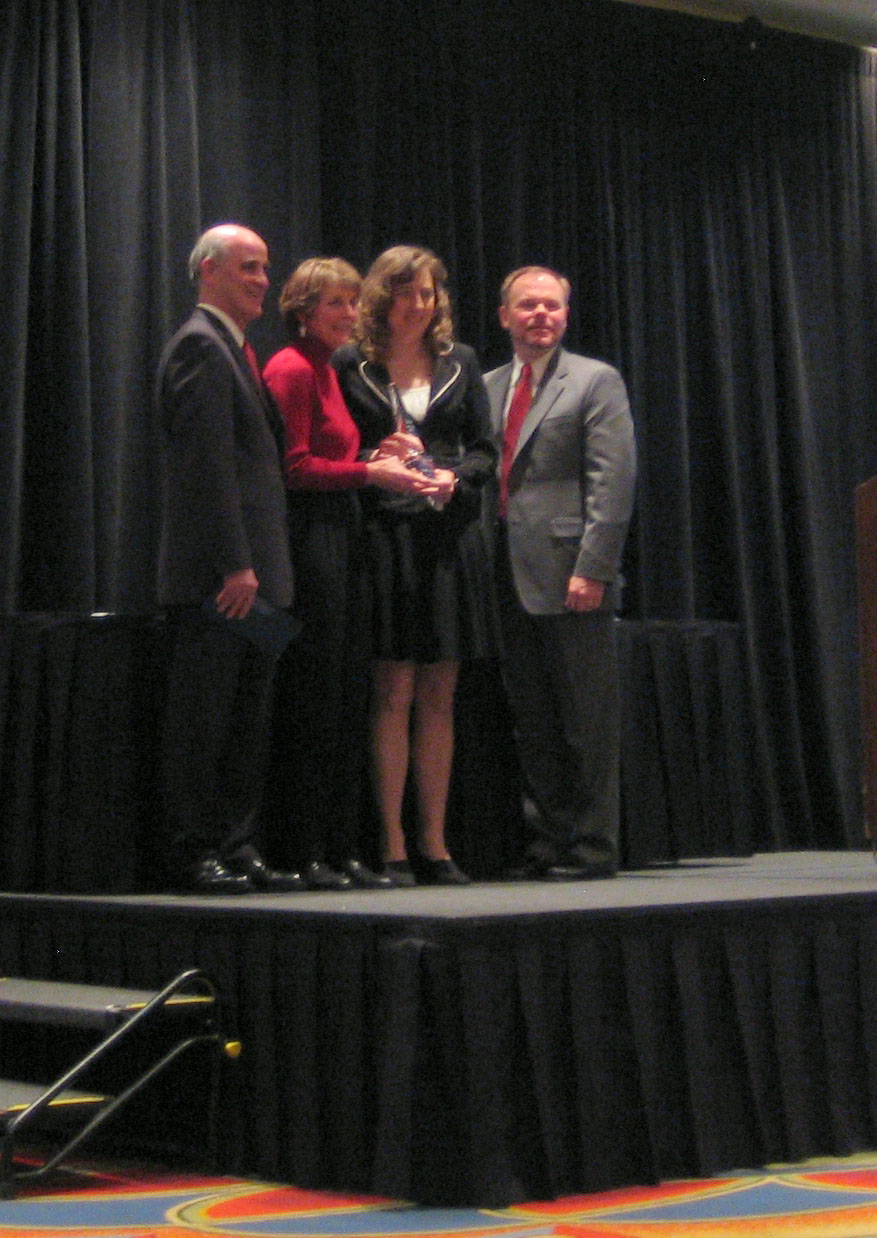
(Ms. Heidi Anderson a former UK Alumni)........ .......... .......... .......... .......... .......... .......... .......... ..Being awarded the NTSA award in Calif.
High School Students:
As for high school students, my lab is very dedicated to mentoring students in their research laboratories. In fact, some of the high school students have won Internationally recognized awards for their Science projects conducted within our research programs.
For other endeavors
of High School students' research in our lab see:
http://web.as.uky.edu/Biology/faculty/cooper/High
school OUTREACHING.htm
In 2005 Mr. Clay
Turner, an 11th grade Lafayette High School Student, conducted research
in our laboratory at UK and obtained $500 for his research from the UK-
KY Young Researchers Program.
What this opportunity allowed Clay was to conduct research
related to a research project that he could use for his science fair project and
to travel to various scientific meetings.
In addition he won an award at the UK Regional Science and Engineering fair to proceed to the international INTEL competition. There he was awarded a University Scholarship worth 20,000.
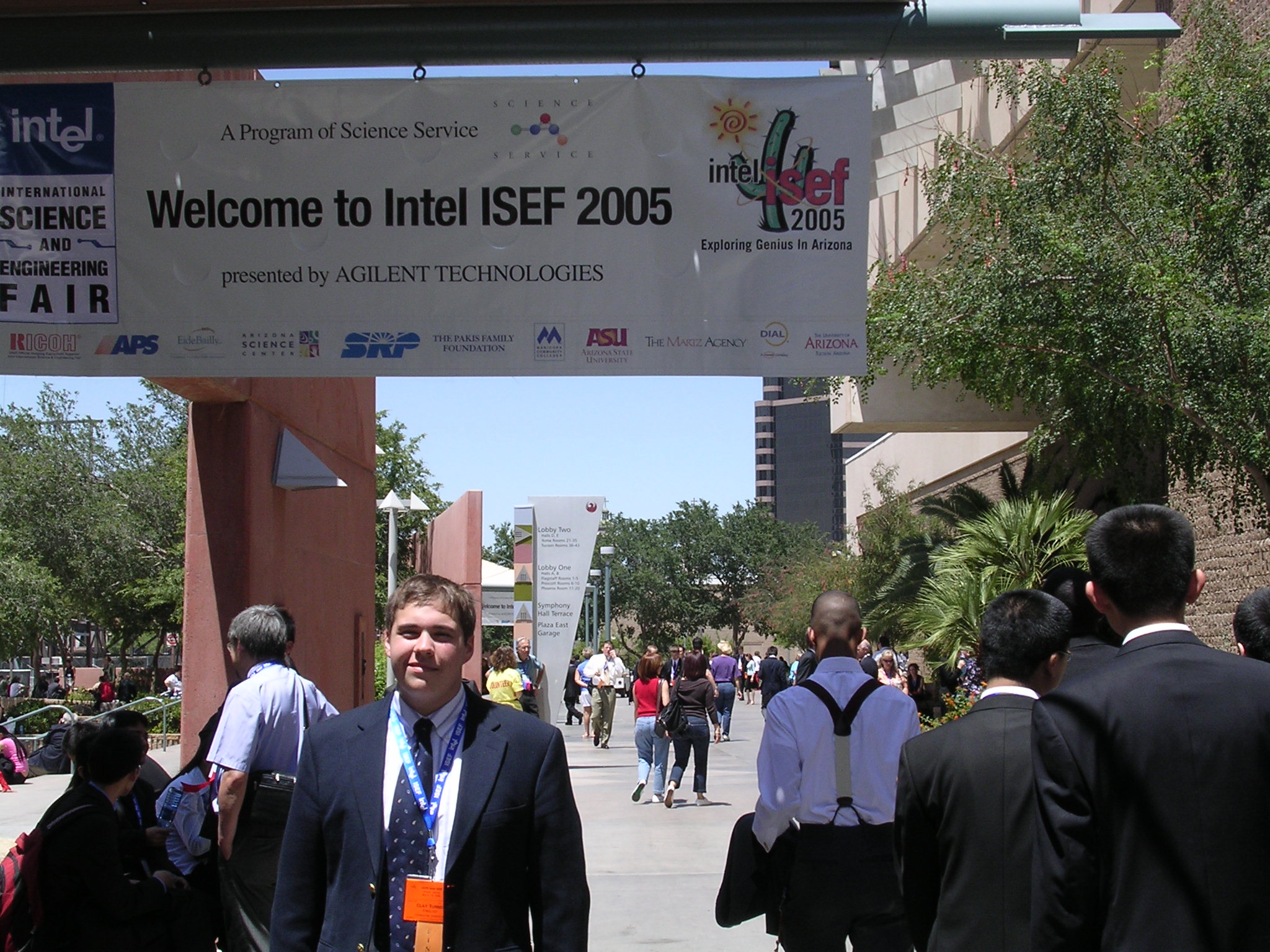 (Mr. Clay Turner at the INTERNATIONAL INTEL Science fair)
Mr. Turner's
project was entitled "THE EFFECTS OF AN ALTERED SEROTONINERGIC SYSTEM ON
BEHAVIOR AND DEVELOPMENT IN DROSOPHILA MELANOGASTER"
An abstract
of his work:
Drosophila is a simple model system that provides an advantage over vertebrates to modify genetically and for electrophysiological studies on identifiable cells. In this organism the sensory-CNS-motor circuit is modulated by serotonin (5-HT) in larvae which gives one insight that this neuromodulator is playing a role in central neuronal circuits. The role of 5-HT in the behavior and development of Drosophila melanogaster larvae is being studied. p-CPA (para-chlorophenylalanine) blocks the synthesis of 5-HT by blocking the enzyme tryptophan hydroxylase. The larval development is slowed by pCPA. Locomotive behavior and mouth hook movements is also reduced in 3rd instar larvae that were fed pCPA since the 1st instar. Antibody staining of the larval brain for 5-HT shows a reduction in intensity of 5-HT in animals fed pCPA. This studies shows that pCPA reduces 5-HT production which also correlates with reduced larval development and altered behavior.
The various presentations that Clay Turner has given related to his research are the following:
1. C. Turner (2005) The effects of an altered serotoninergic system on behavior and development in Drosophila melanogaster. Local Bluegrass chapter for the Society for Neuroscience meeting at Keenland in Lexington, KY. (March 15, 2005).
2. C. Turner. (2005) The effects of an altered serotoninergic system on behavior and development in Drosophila melanogaster. The Central KY Regional Science & Engineering Fair held on UK campus March 26, 2005
3. C. Turner. (2005) Science fair project. The Jr. KY Sciences held on Campbellsville University (KY) campus April 16, 2005.
4. C. Turner. (2005) Science fair project. The Intel International Science and Engineering Fair (Intel ISEF) held in AZ.
5. Turner, C.,
Dasari, S., and Cooper, R.L. (2006) Influence of the dopamine and serotonergic
systems on physiology, development and behavior of Drosophila melanogaster.
Society for Integrative and Comparative Biology. Annual meeting. Orlando,
FL. January 4-8.
Middle School Students:
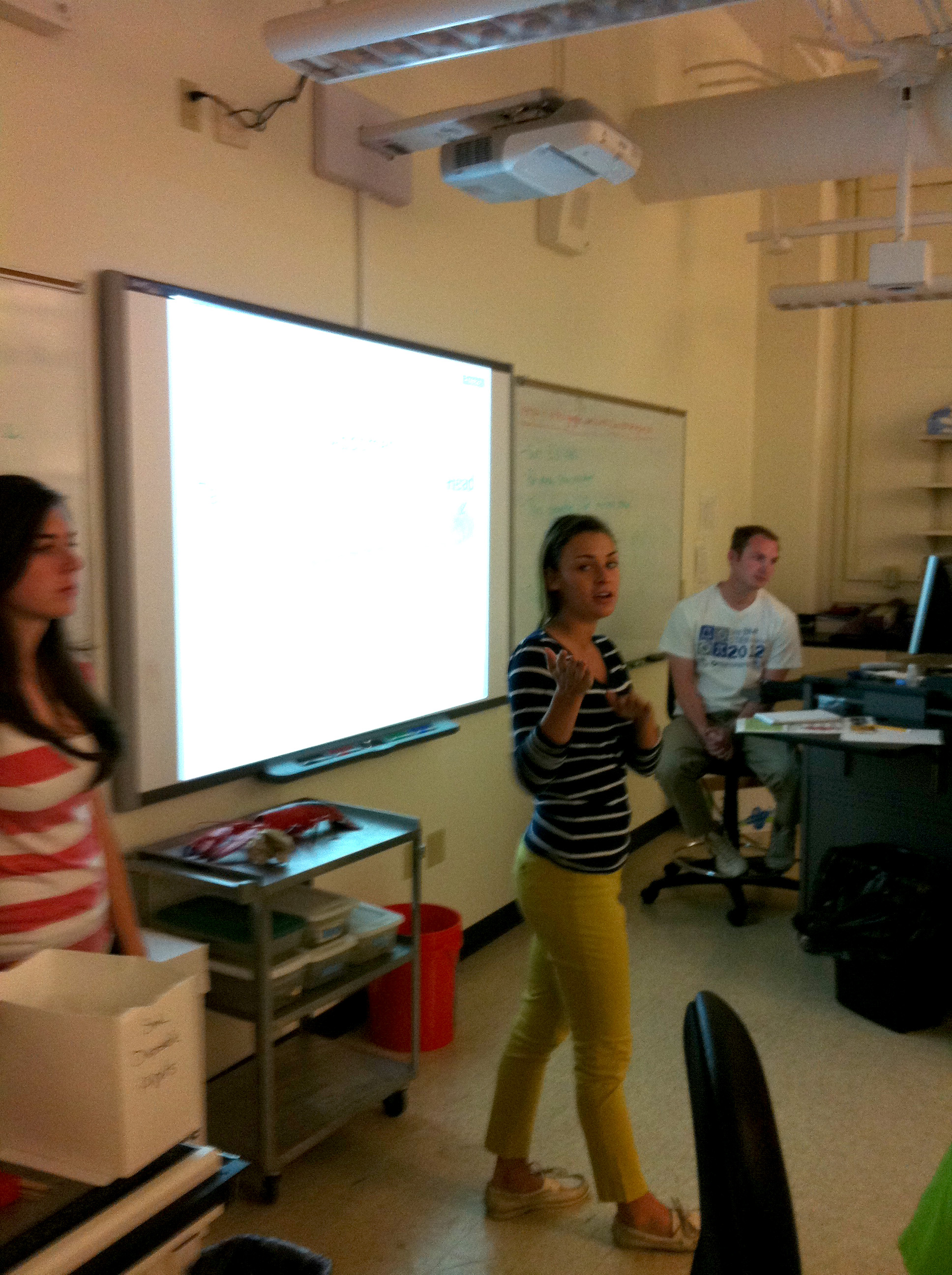
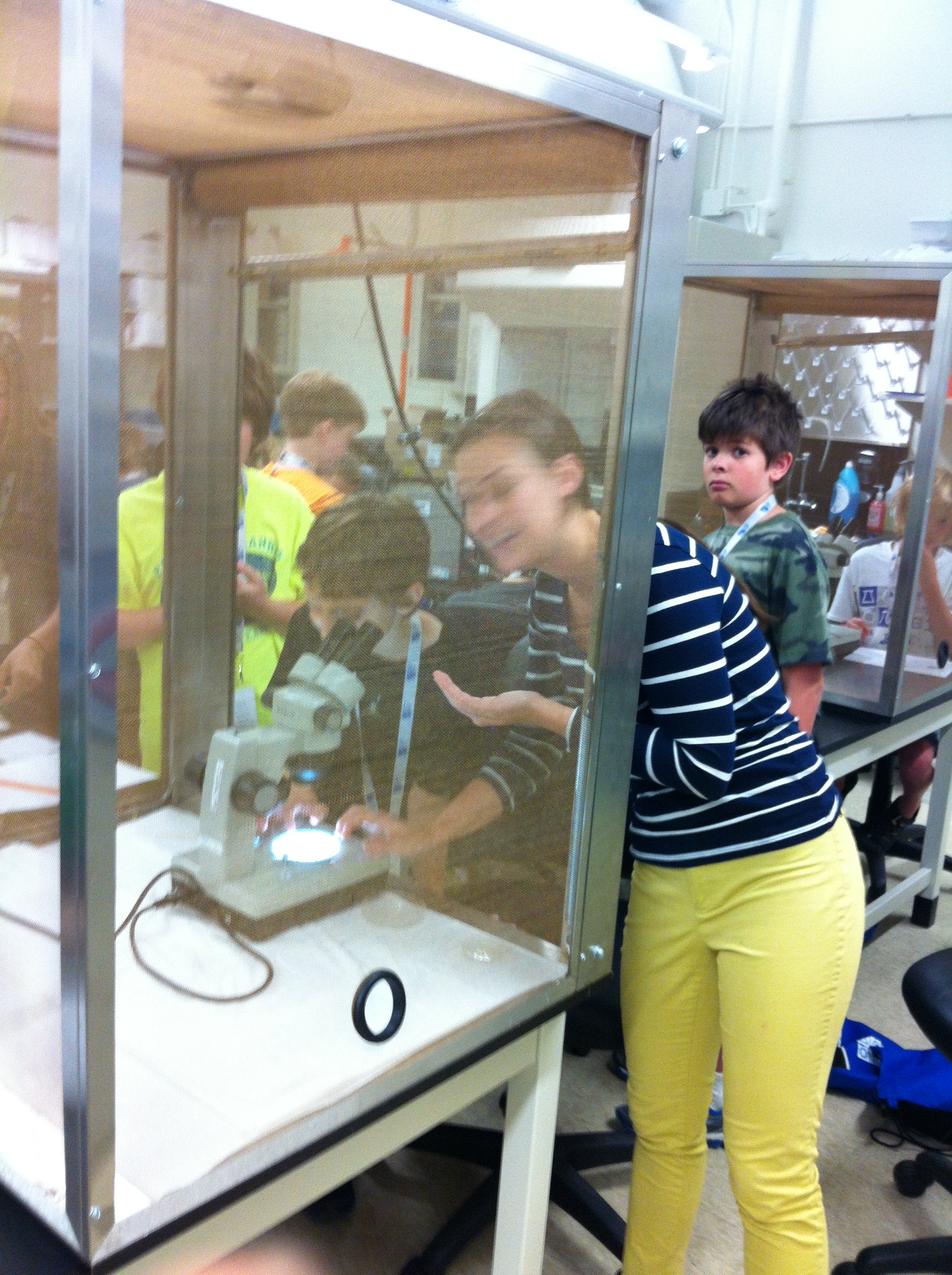
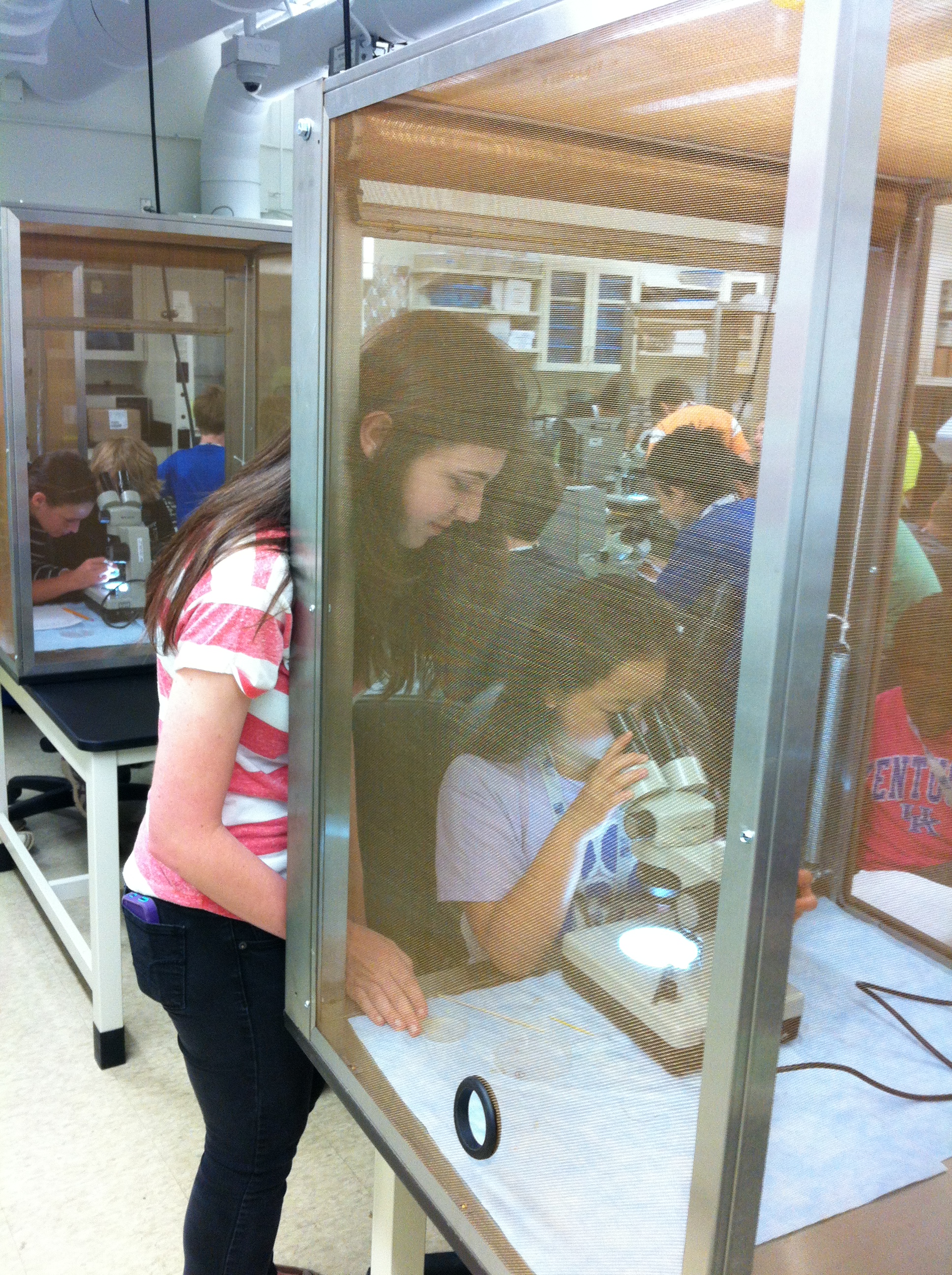
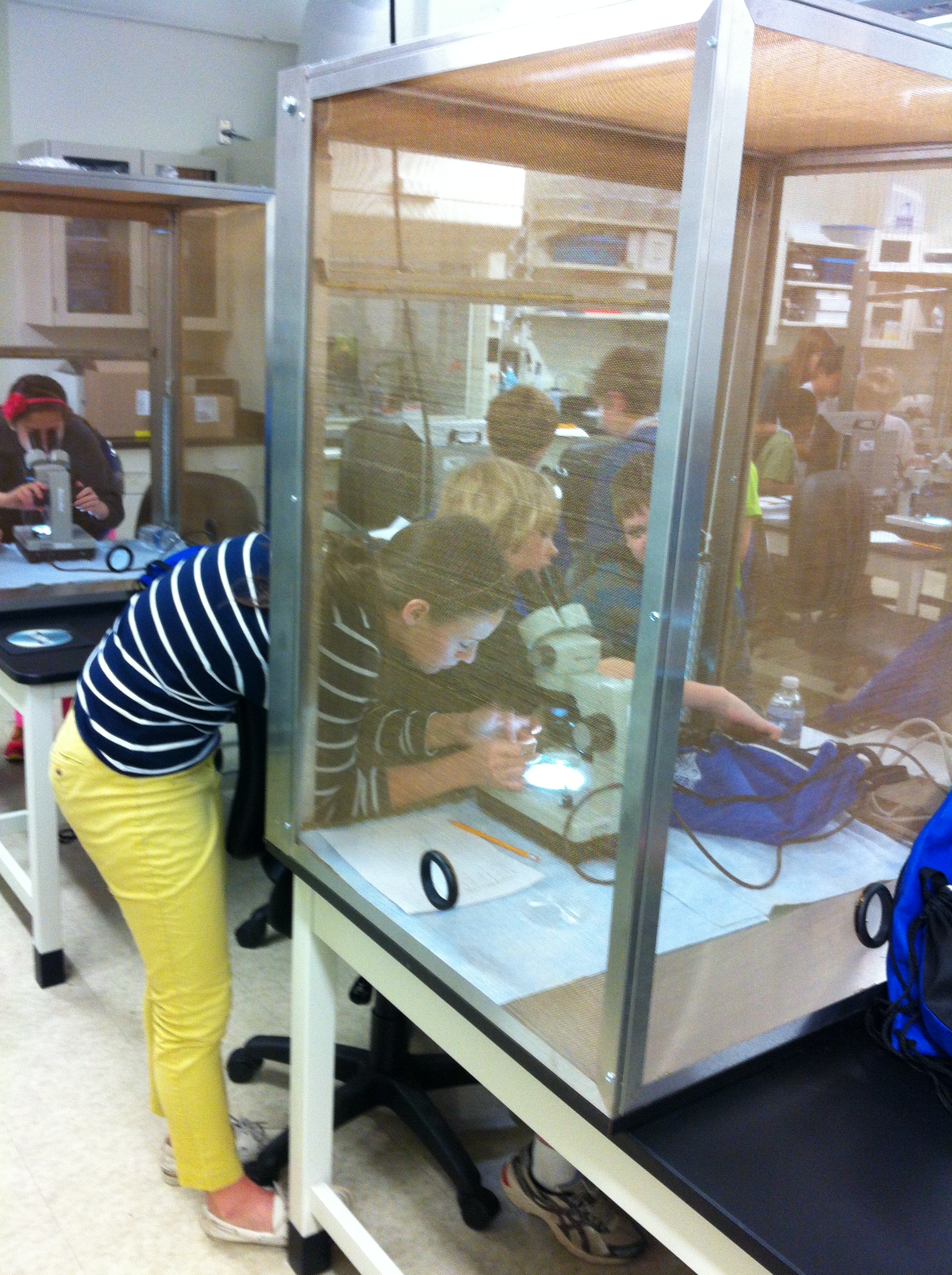
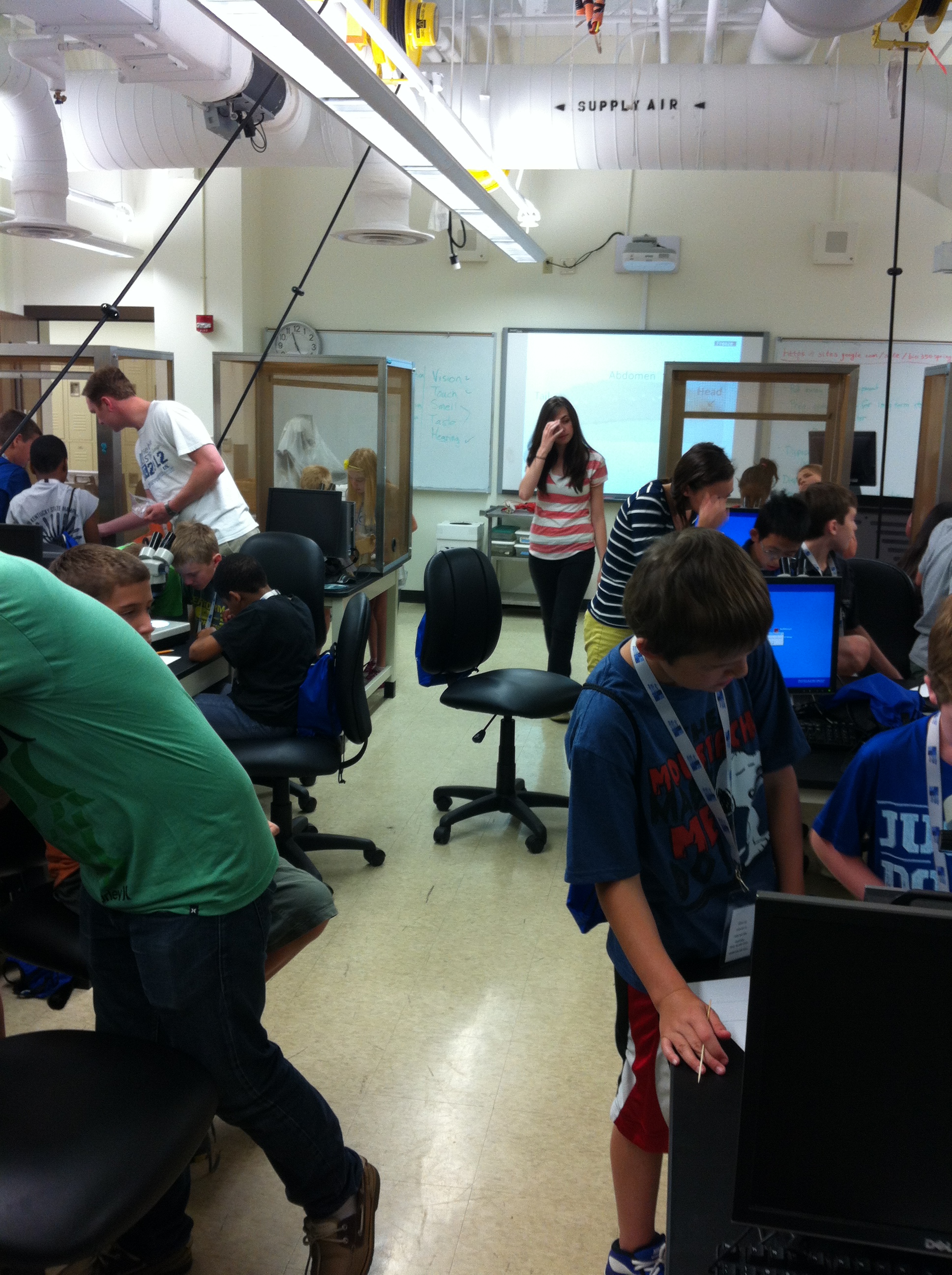
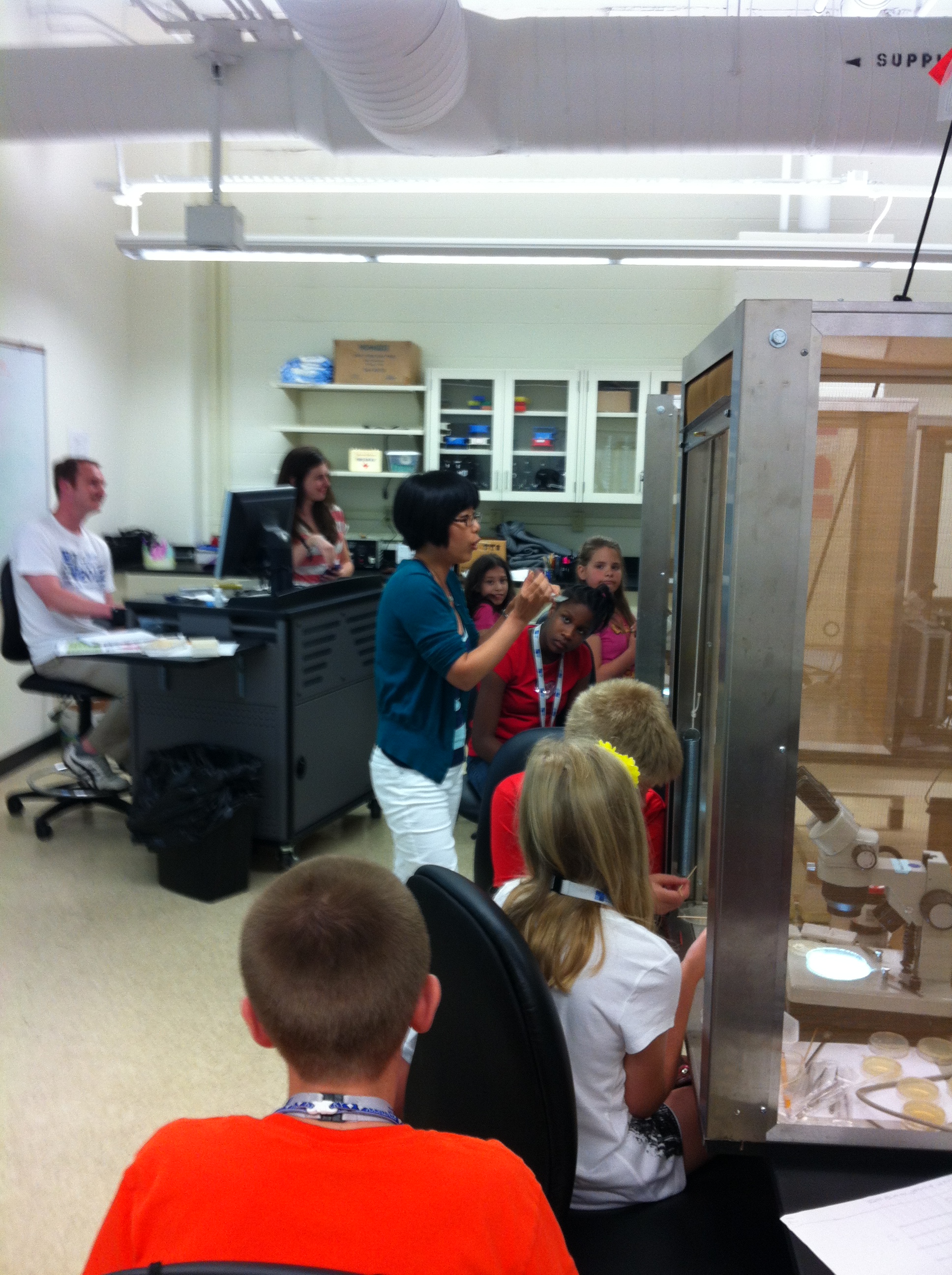
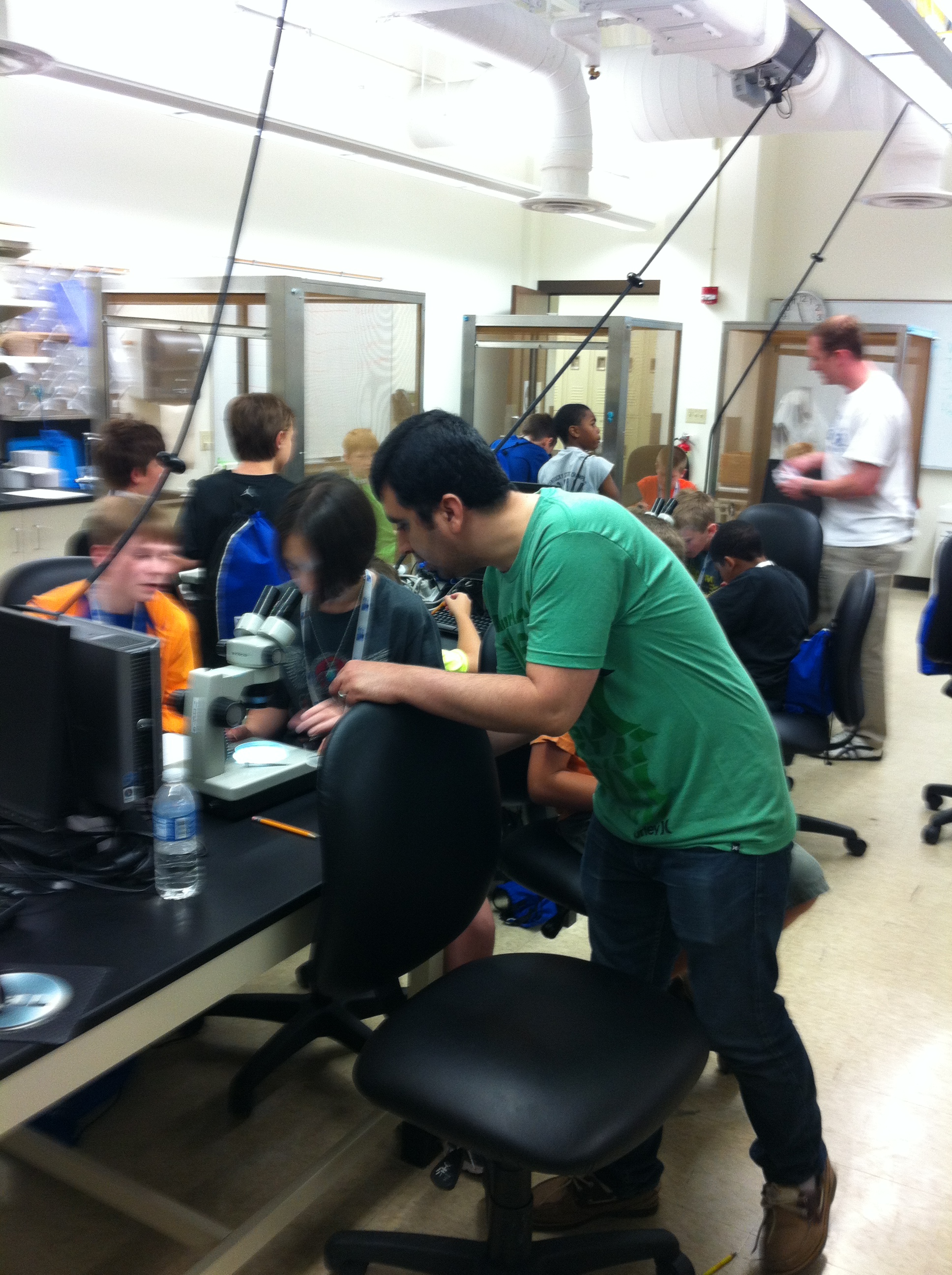
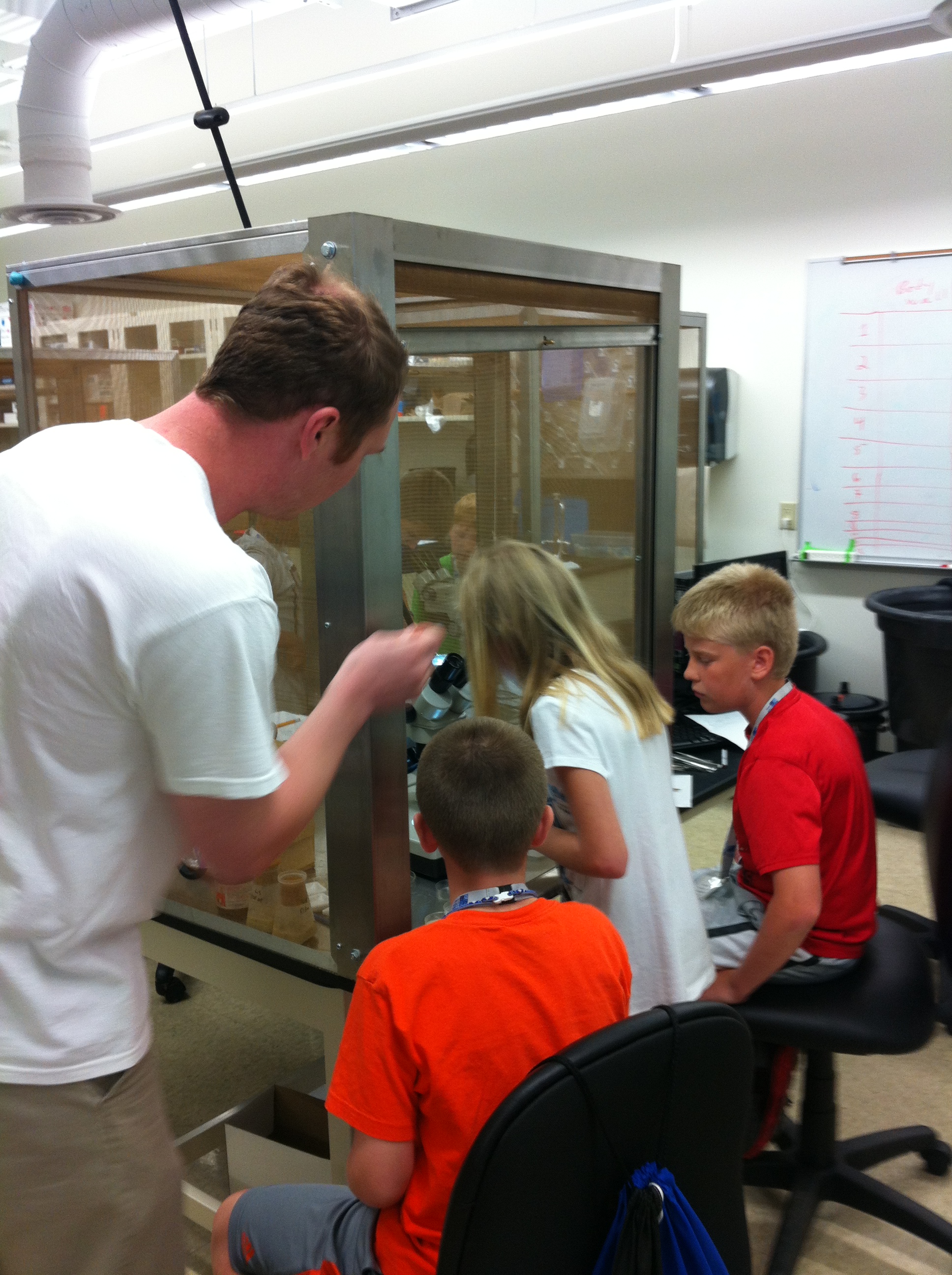
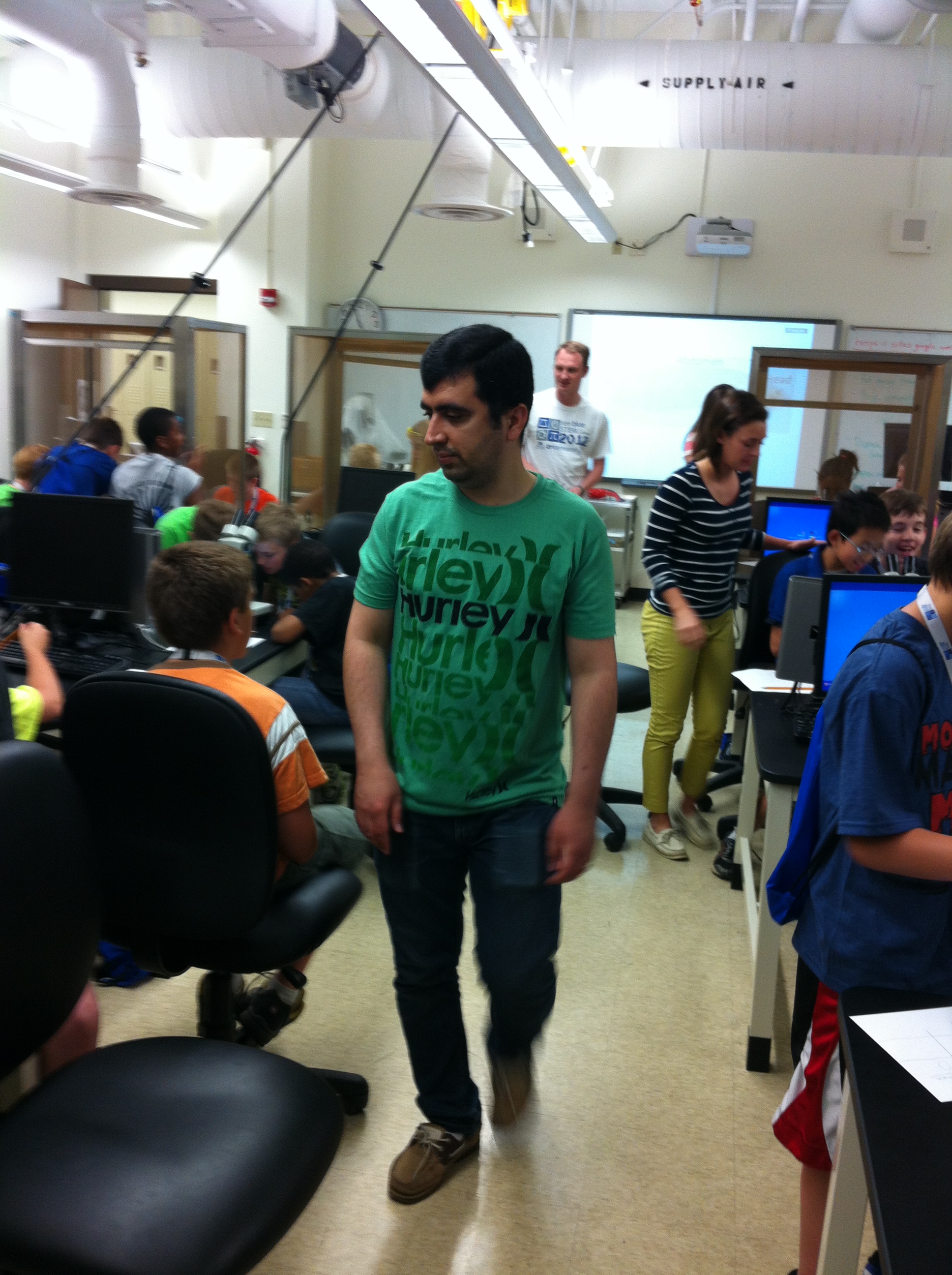
June 2013: Ran activities for Middle School Summer STEM-Blue Camp at UK Dept. of Biology. Funded by American Honda Foundation. Spent two days with four sessions (AM and PM, 4 hours each session, 35 students in each session). Two preparation days required.
FUNDING RELATED TO OUTREACHING
-----GRANTS Received:
1. Feb. 11, 2013. Kentucky Department of Education. MUSE - modeling for understanding in science and engineering. Kentucky's Mathematics and Science Partnership (MSP) 2013. Kentucky Department of Education $140,000 for year 1 (January, 2013 to September 30, 2013) and at $195,000 for the second year (October 1, 2013 to September 30, 2014), with a possible third year (at $97,500). PI. is Kimberly Zeidler-Watters, Partnership Inst. for Math and Science. CO-PI Robin Cooper.
2. KY Department of Education. Start 10/01/12 End 09/30/13. Science Leadership Support Network - Central Region Year 3. # 3048109915. PI. is Kimberly Zeidler-Watters, Partnership Inst. for Math and Science. CO-PI Robin Cooper. Total $97,500.
3. KY Department of Education. Start 10/01/12 End 09/30/13. Science Leadership Support Network - Eastern Region Year 3. # 3048109914. PI. is Kimberly Zeidler-Watters, Partnership Inst. for Math and Science. Only one CO-PI Robin Cooper. Total $97,500.
4. Toyota Motor Manufacturing Kentucky for support of Kentucky Science and Engineering Fair. $3,000. Dec. 14, 2011. (PI. Cooper) Funds to support the science fair and students travel to attend INTEL. Grant ID: XX52454953
5. 2010-2012 The P-12 Math and Science Outreach Unit of PIMSER in partnership with OSPA, UK College of Ed, and UK was awarded 2 of the 5 state Math and Science Partnership projects to design and facilitate a Science Leadership Support Network in the Central and Eastern region of the state. UK will receive $195,000/project per year x 2 years so approx. $800,000 total. The higher ed partners for the funded projects are: Central KY (Christine Schnittka, Becky McNall, and Robin Cooper). [Kim Zeidler, University of Kentucky is the PI]. Awarded in 2010.
6. Council on Postsecondary
Education (2006-2007). US. Dept. of Education to States to meet the no
child left behind act. The Teacher and Principal Training and Recruiting
Fund authorizes allocations for the Improving Teacher Quality State Grant
Program (CFDA #84.367B), which Kentucky calls the Improving Educator Quality
Program. The program gives Kentucky the flexibility to fund high-quality
teacher and principal training, grounded in scientifically based research,
in all core academic subjects. In return, the state and the grant recipient
will be held to stricter accountability measures to ensure improvement
in the quality of educators and the performance of students. ($120,000,
PI. Carol Hanley; Lead UK Contact is Robin Cooper).
My unpaid role was to conduct teacher workshops and provide on-site support
to Wolf and Woodford county participating high schools. This amounted
to 2 visits to each school as well as a 1 week teacher workshop at UK
for the 15 teachers. Other grant instructional participants visited other
schools that enrolled in the year long thematic topics.
7. NIH-KBRIN (Kentucky Biomedical Research Infrastructure Network) Support of the National Institutes of Health and the National Center for Research Resources Grant P20 RR16481, Summer 2004. $39,386. For teaching a 'hands-on' course in neurophysiology in conjunction with training students in use of transmission electron microscopy and statistical analysis of data.
8. NSF-OIB: RET
Supplement to my NSF Grant for $20,000 for Summer 2005 [RET is Research
Education for Teachers - Science teachers].
9. Kentucky Young
Researchers Program (Univ of KY internal grant). Two awards provided for
supplies related to mentoring research in the lab for high school students.
$1,000 (2004-2005).
10. Initiated and
succeeded in obtaining an IBRO 1993 international neuroscience hands-on
workshop in Summer
Seoul, South Korea. Obtained funding ($25,000 USD) for this workshop from
IBRO and Brain Research Foundation, Tokyo.
-------Participant on Awarded Grants:
1. 2006. Tiered Mentoring Grant from Kentucky Dept. of Education. PI-David Taylor (Science Coordinator Fayette County Public Schools). I serve as a participant on the grant. I am to mentor high school science teachers to learn laboratory and experimental techniques.
2. Science Alliance which is part of Partnership Institute for Math and Science Education Reform (PIMSER). [Kim Zeidler, University of Kentucky is the PI]. I was placed on this grant as a scientist partner at UK. 2006- 2008. I was paid a summer salary from this grant to conduct high school teacher's workshops and lesion planning.
3. Fayette County
Public Schools: Facilitating Operational Communities for Understanding
in Science (FOCUS). I was placed on this grant as the scientist partner
at the Univ of KY 2008- 2009. (David Helm and Lori Bowen are the PI's
on the grant). I obtain no salary. Only the teachers and staff are paid.
This is an altruistic behavior on my part for our local public schools.
Teachers often lack the skills and content knowledge to create in-depth
instructional units based on state standards. The resulting low levels
of relevance and rigor can cause students to be disengaged in what they
are learning in science class. With little time available to work together
with each other or across grade levels, teachers often work in isolation.
The Facilitating Operational Communities for Understanding in Science
(FOCUS) Project establishes an ongoing science education partnership among
Fayette County Public Schools Primary - 8th grade science teachers, district
support faculty, higher education (University of KY) and organizations
in the community. Utilizing research proven strategies, the project focuses
on:
A. improving student achievement in science
B. enhancing Primary - 8 science teachers' science content understanding
C. enhancing Primary - 8 science teachers' implementation of research-based
instructional practices
D. enhancing Primary - 8 science teachers' access to high-quality curriculum
resources
We have found that professional development and teacher collaboration
is greatly enhanced when teachers and other stakeholders view their participation
in an initiative as having application in their work. Project teachers
are participating in a minimum of 80 hours of high quality PD per year,
which includes 56 hours of job-embedded PD, 18 hours of content academy
workshops, and at least 6 hours of field experiences. Participants are
meeting 8 days this school year for job-embedded PD (56 hrs). We spend
mornings developing content knowledge and learning specific elements for
unit development using backwards design. With the support of lead teachers,
participants spend afternoons in teams applying their new learning to
constructing units of study, assessments, and congruent lessons. Participants
work together to self- and peer-evaluate their work, looking at units
across grade levels to ensure a tightly spiraled curriculum. The resulting
high quality instructional resources are shared with the district and
state to serve as models. Contacts: Lori Bowen and David Helm, Fayette
County Schools.
4. Toyota PEP Grant
with Fayette County Public Schools (FCPS) 2011- 2012. Title: "Biology
Realignment and Curriculum Enhancement (BRACE)." I was placed on
this grant as the scientist partner at the Univ of KY. No other faculty
member at Univ of KY is a participant on the grant. (David Helm at FCPS
is the PI's on the grant). $ 30,000
Goals of the grant are:
1 - Align the current Kentucky Program of Studies for Biology with the
recently released ACT Quality Core which the Biology End of Course Assessments
will be based on
2 - Training on implementation and use of equipment recently purchased
DNA technology equipment (gel electrophoresis equipments, PCR thermo cycler,
etc.)
3 - Continued work on the implementation of Science Literacy Standards
released last year as a part of the career and college readiness standards
for Language Arts.
Health Related Community Service in Lexington, KY & local areas
1. Presentation and activity on the importance of good respiration with pH balance for elderly and people with COPD: Concerns with oxygen therapy. Presentation to students in High School Biology classes (2 different classes). FCPS, Southside Technical Center, Lexington, KY. Feb. 1, 2012. Contact: Ms. Shannon Raymer, RN, MSN, CCRN
2. Volunteer multiple times in evenings as a RN (Registered Nurse) for Mission Clinic at the Baptist Church, Frankfort, KY. (~50hrs within 2012).
3. Presentation and activity on the importance of good respiration with pH balance for elderly and people with COPD: Concerns with oxygen therapy. The Lexington Senior Center. February 7, 2012. Contact: Mr. Wright.
4. Presentation and activity on the circulatory system: Concerns with obesity and arthroscleroses. The Lexington Senior Center. "Did you know presentations" April 2, 2012. Contact: Mr. Wright.
5. Developing a web page (in progress) to contain information on COPD and oxygen therapy along with general education on physiological buffering by the body. This content is targeted for home health care staff and educators on the subject to help the general public to understand the topics. https://sites.google.com/site/copdwitho2care/ . Also, a flier is provided for general public use. Download here ( pdf or publisher file).
Conducted 3 workshops for 2012 National Science Teachers Association (NSTA) Regional Conference in Louisville (October 18-20).
(1) Cooper, R.L., Holsinger, R.C., Rose, S., Cooper, H., Krall, R.M., Johnson, D. and Zeidler-Watters, K. (2012). STEM & Health: Stressors on the circulatory system related with excess body fat.
(2) Holsinger, R.C., Cooper, R.L., Krall, R.M., Johnson, D. and Zeidler-Watters, K. (2012). Effect of Environment and Modulators on Hindgut and Heart Function in Invertebrates: Crustaceans and Drosophila.
(3) Holsinger, R.C., Cooper, R.L., Cooper, H., Krall, R.M., Johnson, D. and Zeidler-Watters, K. (2012).Classroom activity on buffering related to respiration for high school and introductory college courses in biological sciences.