Research goals of my laboratory are to understand
the physiological mechanisms involved in synaptic plasticity among neurons
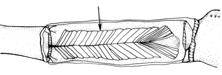
in vivo and in situ. The phasic and tonic motor neurons associated with
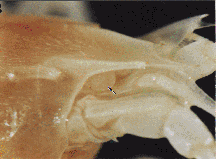
crayfish neuromuscular junctions (NMJ) lend themselves for relatively
easy physiological and molecular experimentation. With electrophysiological
tools, the intrinsic differences in synaptic efficacy of tonic and phasic
neurons are being investigated. In addition, we are investigating the
mechanisms underlying the synaptic plasticity involved during the experimentally
induced transformation of phasic to tonic motor neurons. In this system
of phasic, tonic and transformed phasic motor nerve terminal, we are
assessing the effects of neuromodulators, known to be present in the
crayfish hemolymph. In addition, we are examining the role of neuromodulators
on alterations of activity in primary sensory neurons and the integration
of the sensory input. Molecular based projects are aimed at determining
which particular proteins are utilized during the various stages of
synaptic transmission.
A more recent goal for the lab is the function and modulation of Drosophila
cardiac muscle and skeletal muscle injury in the crayfish as well
as mammalian models related to health and disease. The Drosophila projects
revolve around the pharmacology and cellular mechanisms associated with
dopamine, serotonin and other compounds on the larval heart. The skeletal
muscle projects are centered on muscle injury models and use dependent
plasticity. A medical problem, in a sense of rehabilitating clients and
maintaining clients at their maximum health potential, is preventing further
muscle/cellular damage due to the spread of the initial injury associated
with a deep tissue injury (DTI). The causes of DTI are multifactorial
and can involve a complex series of events. Various causes arise from:
bone/muscle interface deformation, ischemia, ischemic reperfusion injury,
impaired lymph drainage, alteration in interstitial fluid flow, alteration
in capillary wall permeability- edema, and inflammatory changes conducive
to apoptosis. Since there are many different primary causes of the progression
of DTI one might indeed expect the treatments to be varied. A health care
provider is basically interested in how to prevent further muscle or tissue
damage as a result of the primary injury. A primary concern is to prevent
skin breakdown if the skin is not already comprised. The concern with
an open wound is related to being susceptible to infection and having
the wound heal. The general treatments for a DTI are wide ranging but
usually have one of the following or a mix as a treatment: increasing
blood flow with movement, apply heat, apply cold, use of medications such
as anti-inflammatory compounds (non steroidal anti-inflammatory drugs,
NSAIDs) for blocking prostaglandins production, and use of steroids such
as glucocorticoids to reduce swelling. Basically the current recommendations
follow accepted standard of care for treating pressure ulcers. We are
examining alternative measures for treatment of DTIs and work closely
with the Center for Muscle Biology at the University of Kentucky (link).
I have also broadened my research goals to understand how animals can
alter properties of neurotransmission by their behaviors which are expressed
during development and in the adult stages when animals are subjected
to various physiological and ecological stresses. This line of research
encompasses genetic, physiological, behavioral and evolutionary aspects
of the organisms under investigation (visual crayfish, blind cave crayfish,
and Drosophila). An example of one aspect of this broad, life encompassing
research interest is when 2 crayfish are placed together they will fight
until one of the combatants withdraws. The success is based largely on
physical size. The establishment of dominant and submissive individuals
by behaviors have an effect on survival and reproduction of the species.
A number of recent findings have implicated the levels of neuromodulators
in the nervous system to be the sole factor in establishing a dominant
or submissive status. The amine, serotonin in particular, has been implicated
in the control of aggression in crustaceans and most vertebrate species,
including humans. I plan to substantiate if serotonin really is a major
player in establishing the behavioral status of crayfish by bioassays
of the levels in the blood while animals are establishing their social
status. Various factors such as the state of hunger, visual cues, parasitism
and pheromones are currently being addressed in relation to social status
among crayfish in my laboratory. We are also addressing learned verus
innate behaviors among visual, visual impaired and cave adapted blind
crayfish in establishing combats and posturing positions. This will bring
us full circle to genetic variations over evolutionary time scales among
species and the effects of neuromodulators on neural circuits which have
evolved to carry out given behaviors.
Multiple research disciplines are being examined separately but they
are all interrelated. With the successful outcome of published findings
over the last 4 years from my laboratory, I believe this approach will
continue to bare fruit.
Specific research topics are as follows:
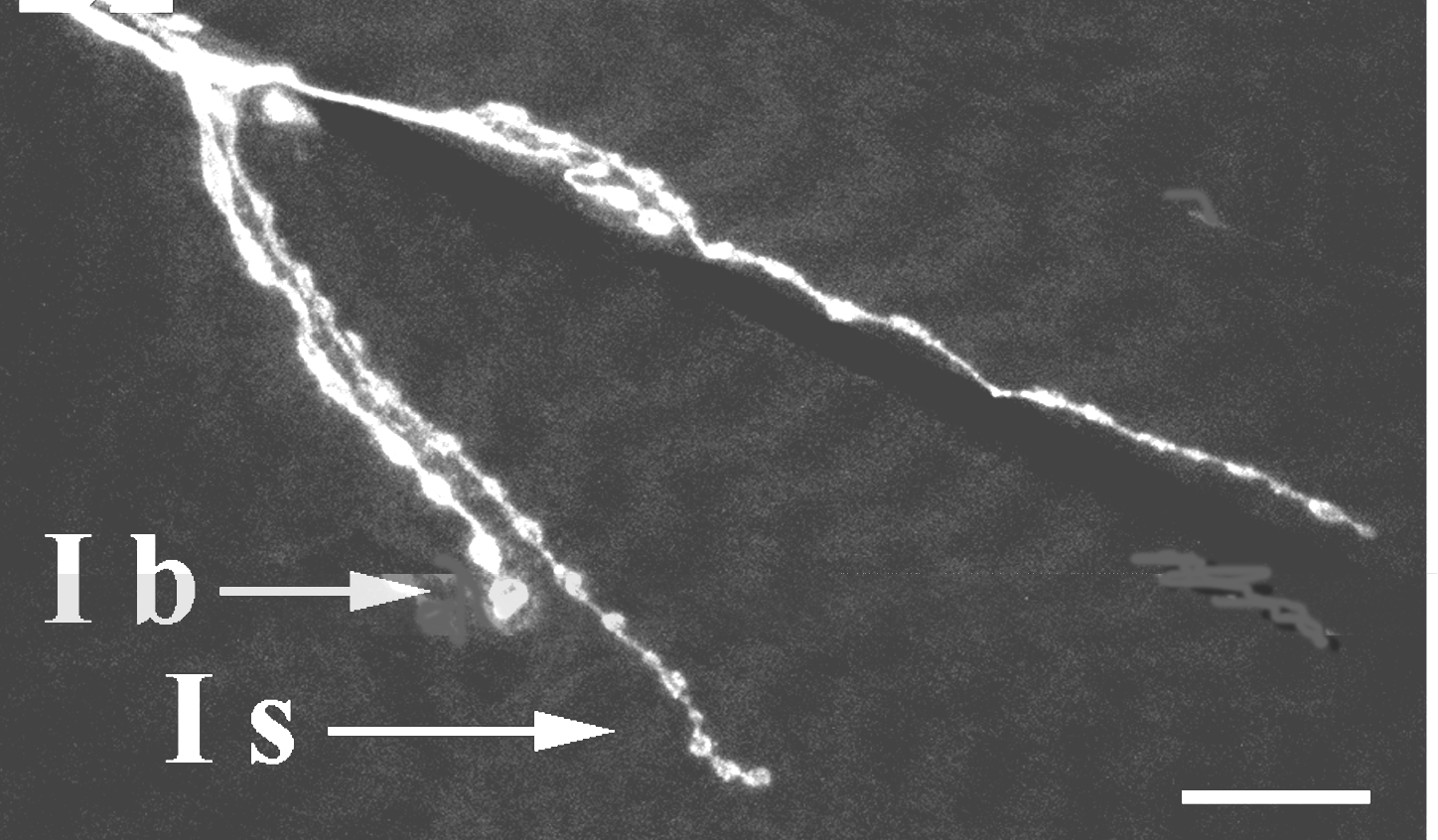
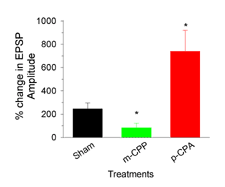
(A) Neuromodulation of identified sensory and
motor neurons.
The long-term objective of this project is to understand not only the
detailed mechanisms of synaptic differentiation among neurons but also
those mechanisms employed between neurons and muscle cells. The nerve
cell is chemically integrated with other cells at morphologically-identified
locations called synapses. The characteristics of the synapse are affected
by its activity level which modulates long-term alterations in both synaptic
structure and performance. Neuromodulators that are endogenously released
either enhance or suppress synaptic efficacy, in turn affecting the behavioral
state of an animal. Neuromodulators affect cellular process by various
intracellular messenger cascades that are dependent on the type of neuromodulator
and its associated receptor. Such changes are believed to play a role
in learning and memory, as well as in the behavioral state of an animal.
The crustacean and Drosophila nervous systems lends themselves
to easy experimentation and provide direct correlation of structure and
function at identified, single cells, as well as at individual synapses.
These model nervous systems not only provides for an assessment of the
effects of neuromodulators on well characterized behaviors, but also allows
correlation between identified synapses and certain behavioral components,
thus permitting the identification of specific, cellular mechanisms underlying
synaptic differentiation. With the use of recent pharmacological compounds
and fluorescent dyes, mechanisms by which neuromodulators influence neurotransmitter
release, either transiently or long-term, may now be addressed. An established
and precise method of identifying and recording from a synaptic site allows
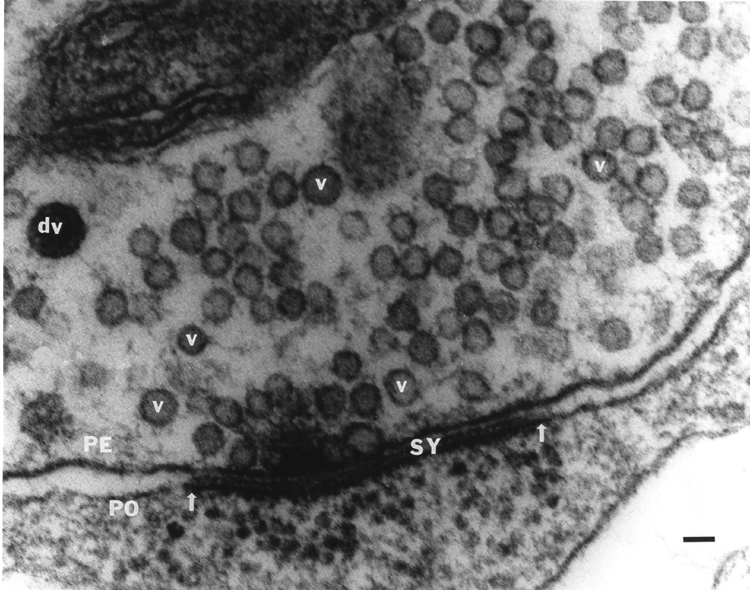
for its subsequent serial reconstruction using electron microscopic techniques.
Since the axons of the motor neurons are relatively large in crustacean
nervous systems, intracellular injections of compounds ease the dissection
of intracellular signaling systems either in the absence or presence of
neuromodulators. Additional effort in this area will provide a clearer
understanding of the mechanisms employed by neuromodulators that result
in a behavioral change in response to alterations in the nervous system.
[See
Latest Reseach]
(B) Quantal assessment of neurotransmission.
We continue to develop better methods in assessment of quantal methods
utilized to assess synaptic transmission. These methods have been taken
in to practice by the scientific community.
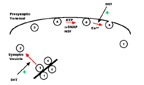
(C) Understanding the basic components involved
in vesicular release at nerve terminals.
Other aspects of research efforts are continuing in collaboration with
Dr. Sidney Whiteheart in the Dept. of Biochemistry at the UK Medical School.
He is carrying the molecular based research efforts while I advance the
physiological based experimentation. The initial investigations of a synaptically-relevant
molecule, alpha-SNAP (He et al., 1999; MS Thesis from my lab) suggest
that other molecules may be used similarly to address their functional
significance in synaptic transmission. Molecules that dock synaptic vesicles
are of special interest.
(D) Skeletal muscle physiology and
pathology
We plan to develop rodent injury models along with parallel processing
human assessment data related to DTIs reports. This development in protocols
is needed for processing an IRB/ IACUC approval for the future rodent
experiments as well as in data gathering in human studies for an NIH submission.
This proposed research plan is directly fitting for the prevue of funding
by NIH-Nursing in improving the quality of life and health of people.
The tangible results will be presented in publications, presentations
and grant submissions. This process has already begun in the lab with
presentations. We have been using crayfish and Drosophila muscle models
for a number of years (~20yrs) and have published several articles and
work from this related project has been presented at the Society for Neuroscience
meetings in the area of disuse atrophy, motor nerve transection and motor
nerve terminal function. We have presented a poster on the effect of electrical
activity of a neuron on the potential of raising extracellular K within
a nerve sheath and having an influence on surrounding neurons (i.e., ephaptic
transmission). In fact, we have developed undergraduate laboratory procedures
for the Bio350 course in which students raise the extracellular K+ and
measure the effects on the resting membrane potential of skeletal muscle
in crustacean models. In addition a new course has been developed specifically
on skeletal muscle of mammals.
(E) Sterological methods for characterization
of synaptic structures
We have continued projects that develop quantitative techniques for reconstructing
the dimensions and spatial distribution of synaptic structures in the
pre- and post-synaptic tissue from conventional transmission electron
microscopy. To distinguish two aspects of the problem: (1) The reconstruction
of size and shape of an object; and (2) The problem of resolving small
changes of optical density associated with thin slices of these structures.
The analysis should allow one to obtain information on the following synaptic
structures: (1) vesicles; (2) presynaptic dense bodies associated with
the active zone; and, (3) non-spherical objects such as synaptic areas.
It is very important to understand, quantitatively, the scale of morphological
features when trying to draw comparisons between specimens. This is especially
relevant to our projects of ultrastructural differences in high-and low-output
synapses and interconversion of phasic to tonic motor neurons.
|